
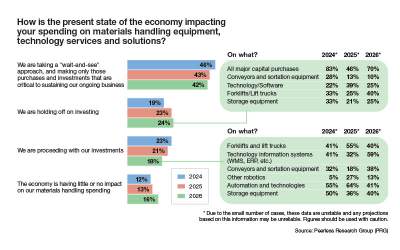
Modern Materials Handling’s 2026 Outlook Survey, released around July 26, 2026, captures a nuanced picture of near-term caution alongside rising longer-term confidence in materials handling, warehouse automation, robotics, and software. Conducted by Peerless Research Group in conjunction with Modern Materials Handling and Logistics Management, the survey of qualified decision-makers shows that while a slightly higher share of companies report holding off on investments or taking a wait-and-see stance compared with the prior year, those who are proceeding often plan higher budgets. Average anticipated spending on materials handling equipment and information systems over the next 12 months rises sharply to roughly $542,000 from under $402,000 the year before, although the median remains modest, indicating a widening gap between transformational investors and more incremental adopters.
Current use of AMRs or AGVs stands at 16 percent (up from 10 percent), with 27 percent evaluating them within one to two years. Industrial robot adoption reaches 21 percent (up from 13 percent), with another 24 percent planning evaluation. Primary applications for AMRs and AGVs include storage, each-picking and place tasks, bin picking, and part-to-picker order fulfillment.
Software interest is pronounced: data-capture technologies, asset management, WMS, and especially WCS (showing an 8-point rise in planned activity) rank high, alongside labor management systems. Respondents also signal growing attention to automated generation of key performance indicators for inventory, order-fulfillment cost, and other metrics. Top current challenges include workplace safety, company growth, cost containment, capital availability, and labor availability.
Looking two years ahead, training, cycle-time pressure, ergonomics, operational advantage, and disaster contingency planning rise in relative importance. E-commerce fulfillment methods continue to evolve, with shipping from distribution centers expected to gain share. Overall the survey indicates that automation is expanding from isolated use cases into broader system-level strategies focused on labor reduction, throughput gains, orchestration via controls software, and data-driven performance management, even as short-term economic caution tempers immediate capital outlays.