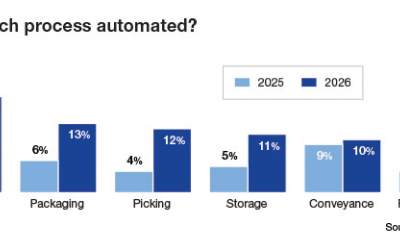
The 2026 Automation Study from Peerless Research Group and Modern Materials Handling, published around July 27, 2026, provides detailed insights into how warehouse and distribution center operations are approaching automation investments and technology evaluation. Drawing from responses of more than 120 professionals involved in purchasing decisions, the study covers facilities spanning food and beverage, electrical equipment, chemicals, pharmaceuticals, aerospace, and other sectors, with average facility size around 137,000 square feet and average employment of about 1,095 people. Current full automation levels remain relatively low across core processes: labeling reaches 24 percent, reporting 18 percent, packaging 13 percent, picking 12 percent, storage 11 percent, conveyance 10 percent, and replenishment 9 percent, while retrieval stands at only 3 percent.
Significant portions of operations still rely on mostly or fully manual processes for picking, retrieval, storage, and packaging, though partial automation is more common in conveyance, replenishment, and retrieval. Equipment adoption shows stronger traction. Nearly half of respondents already use conveyor and sortation systems, with a similar share planning implementations or upgrades within two years; goods-to-person picking solutions follow almost identical current-use and planned-adoption patterns.
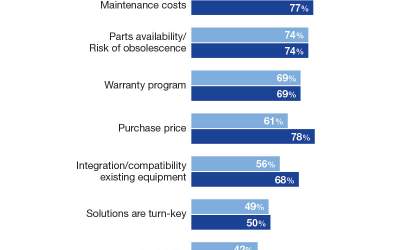
Weighing, cubing, and dimensioning equipment, pocket sortation, automated packaging, automated storage systems including mini-loads and AS/RS, automatic guided vehicles, and palletizing robotics all show solid current penetration and even higher intent for near-term expansion. Buyers prioritize durability, reliability, and uptime (92 percent rating these very important), followed closely by fast service response times (95 percent), total cost of ownership and ROI considerations, parts availability, integration and compatibility with existing systems, and scalability. Key drivers for investment include the need to meet faster order fulfillment SLAs, competitive pressure from peers already automating, support for new go-to-market strategies, and ongoing difficulty recruiting and retaining reliable warehouse labor.
Software forms the connective tissue: warehouse management systems lead at 57 percent adoption, followed by parcel rating tools, labor management systems, computerized maintenance management systems, warehouse control systems, transportation management systems, warehouse execution systems, slotting software, and yard management systems. Planned upgrades over the next 24 months focus especially on yard management, slotting, WES, and CMMS. Average planned spending on materials handling equipment and solutions for 2026 rises to approximately $1.6 million from $1.5 million the prior year, with a wide distribution across budget brackets and roughly one-third of companies expecting increases.
Overall the study portrays an industry moving from isolated pilots toward broader, more integrated automation while still navigating uneven adoption and economic caution.