The 2026 Automation Study published by Modern Materials Handling in collaboration with Peerless Research Group provides a detailed snapshot of current warehouse and distribution center automation adoption, investment priorities, and planned upgrades among more than 120 professionals directly involved in purchasing decisions for materials handling solutions. Respondents represent a diverse cross-section of industries including food, beverage and tobacco (15 percent), electrical equipment (8 percent), chemicals and pharmaceuticals (7 percent), and aerospace (7 percent), with nearly half working inside warehouses or DCs and the remainder split across corporate headquarters and manufacturing-support operations. Facility sizes average 137,054 square feet, with more than one-third exceeding 250,000 square feet; workforce sizes average 1,095 employees (up from 862 the prior year); and company revenues average $675 million.
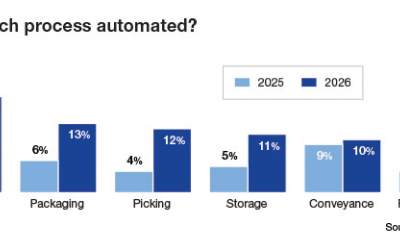
Current full-automation levels remain uneven across processes: labeling leads at 24 percent, followed by reporting at 18 percent and packaging at 13 percent. Picking stands at 12 percent fully automated, storage at 11 percent, conveyance at 10 percent, and replenishment at 9 percent, while retrieval is lowest at only 3 percent. Substantial portions of core activities stay mostly or fully manual with no near-term automation plans—33 percent for picking, 31 percent for retrieval, and 30 percent each for storage and packaging—while partial automation is more common in conveyance (38 percent) and replenishment/retrieval (35 percent).
Equipment adoption shows stronger traction. Conveyor and sortation systems are used by 49 percent of respondents, with 51 percent planning implementation or upgrades within two years. Goods-to-person picking solutions show nearly identical figures (48 percent current use, 51 percent planned).
Weighing, cubing and dimensioning equipment is used by 43 percent, with 57 percent expecting additions or upgrades. Pocket sortation is used by 41 percent today and targeted for expansion by 59 percent. Other categories include automated packaging (37 percent current), automated storage systems such as mini-loads and AS/RS (36 percent), AGVs (35 percent), and palletizing robotics (33 percent).
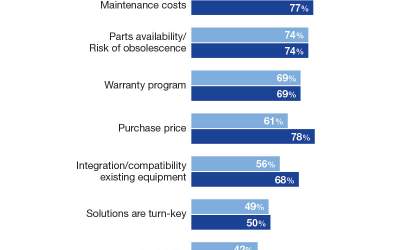
Sixteen percent of respondents anticipate changes to purchasing plans, with most of those shifts expected within six to twelve months. Evaluation criteria emphasize durability, reliability and uptime (92 percent rate these very important). Fast service response times are essential for 95 percent (up from 83 percent previously).
Purchase price is very important to 78 percent (up from 61 percent), total cost of ownership/ROI/maintenance to 77 percent, parts availability and obsolescence risk to 74 percent, warranty programs to 68 percent, integration and compatibility to 68 percent (up from 56 percent), and scalability to 59 percent (up from 42 percent). Environmental and energy-efficiency features rank lower, with 16 percent ignoring them entirely and only 53 percent rating them somewhat important. Primary drivers for investment include faster order fulfillment to meet service-level agreements, competitive pressure from peers already automating, support for new go-to-market strategies, and persistent difficulties recruiting and retaining reliable DC labor.
Software and data-capture layers form the connective tissue. Mobile and wireless technologies are used by 63 percent, barcode scanners by 62 percent, RFID by 47 percent, light-directed picking by 42 percent, and voice or vision systems also appear. WMS leads software adoption at 57 percent, followed by parcel rating tools (55 percent), LMS and CMMS (50 percent each), WCS (49 percent), TMS (43 percent), WES (38 percent), slotting software (36 percent), and YMS (30 percent).
Over the next 24 months the strongest planned focus falls on YMS, slotting, WES and CMMS upgrades. Budget expectations average $1.6 million for materials handling equipment and solutions in 2026 (up from $1.5 million in 2025). Spending ranges widely: 29 percent under $100,000, 16 percent between $500,000 and $999,999, 17 percent between $1 million and $2.49 million, and 16 percent above $5 million.
Thirty-one percent expect overall outlays to rise, 43 percent expect stability, 3 percent anticipate decreases, and 22 percent remain uncertain. The study overall portrays an industry moving from pilot experimentation toward committed, budgeted modernization driven by labor constraints, e-commerce volume and the need for higher throughput and accuracy, while still facing uneven process-level automation and a continued reliance on hybrid human-plus-machine workflows.