Warehouse automation is entering a new phase as companies rethink how they move, store and manage goods under constant pressure to do more with less. Global organizations invested about $21 billion in warehouse automation in 2023, with automated storage and retrieval systems (AS/RS), conveyors, software and robotics ranking among the top picks for modernization. By 2033 that figure is projected to exceed $90 billion, representing a 329 percent increase over a 10-year period and confirming that warehouse and distribution center automation is becoming a core operational requirement.
Key momentum drivers include the ongoing e-commerce boom, persistent labor shortages, and the need to balance cost reductions with improved operational efficiency. The 2026 Automation Study conducted by Peerless Research Group for Modern Materials Handling surveyed more than 120 professionals directly involved in materials-handling purchase decisions. Respondents represent a diverse cross-section of industries: food, beverage and tobacco (15 percent), electrical equipment (8 percent), chemicals and pharmaceuticals (7 percent), aerospace (7 percent) and other manufacturing categories.
Nearly half work inside a warehouse or DC; the remainder are split across corporate headquarters, manufacturing sites and warehouse operations supporting manufacturing. Facility sizes vary widely: more than one-third operate in spaces larger than 250,000 square feet, 24 percent between 50,000 and 100,000 square feet, 23 percent under 50,000 square feet and 18 percent between 100,000 and 250,000 square feet. The average facility measures 137,054 square feet.
Workforce sizes range from fewer than 100 employees (nearly half of respondents) to 1,000–2,499 employees (12 percent); average headcount is 1,095, up from 862 the prior year. Company revenues span the spectrum, with average revenue of $675 million. Current full-automation levels remain modest across core processes.
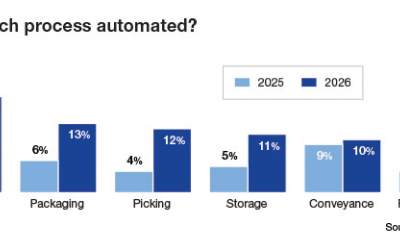
Labeling leads at 24 percent full automation, followed by reporting (18 percent) and packaging (13 percent). Picking stands at 12 percent, storage at 11 percent, conveyance at 10 percent and replenishment at 9 percent; retrieval is lowest at only 3 percent. Substantial manual work persists: 33 percent of respondents report picking is mostly or fully manual with no automation plans, 31 percent say the same for retrieval, and 30 percent each for storage and packaging.
Partial automation is more common in conveyance (38 percent) and in replenishment and retrieval (35 percent each). Equipment adoption shows clearer traction. Forty-nine percent of companies already use conveyor and sortation systems and 51 percent plan to implement or expand them within two years.
Goods-to-person picking solutions are used by 48 percent today with 51 percent planning updates or new deployments. Weighing, cubing and dimensioning equipment is in place at 43 percent of sites, with 57 percent expecting additions or upgrades. Pocket sortation is used by 41 percent and planned for expansion by 59 percent.
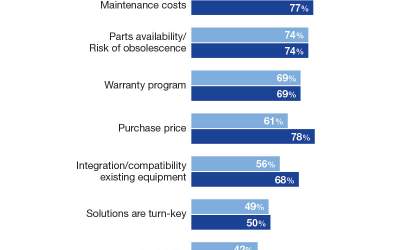
Automated packaging stands at 37 percent, automated storage systems (mini-loads and AS/RS) at 36 percent, automatic guided vehicles (AGVs) at 35 percent and palletizing robotics at 33 percent. Sixteen percent of respondents plan to change purchasing plans for warehouse solutions, with 43 percent of those changes expected within six to twelve months. When evaluating new systems, durability, reliability and uptime rank as very important for 92 percent of participants.
Fast service response times are essential for 95 percent (up from 83 percent the prior year). Purchase price is very important for 78 percent (up from 61 percent). Total cost of ownership, ROI and maintenance costs matter to 77 percent; parts availability and obsolescence risk to 74 percent; warranty programs to 68 percent; integration and compatibility with existing equipment to 68 percent (up from 56 percent); and scalability to 59 percent (up from 42 percent).
Environmental and energy-efficiency features rank lower, with only about half rating them somewhat important. Primary investment drivers are the need to fill orders faster to meet customer service-level agreements, the desire to keep pace with competitors that are automating, support for new go-to-market strategies, and the ongoing difficulty of finding and retaining reliable distribution-center associates. Data-capture and software layers form the connective tissue of these operations.
Mobile and wireless technologies are the most common data-capture tools (63 percent), followed by bar-code scanners (62 percent) and RFID (47 percent). Light-based picking tools are used by 42 percent. Warehouse management systems (WMS) lead software usage at 57 percent, followed by parcel-rating tools (55 percent), labor management systems and computerized maintenance management systems (50 percent each), warehouse control systems (49 percent), transportation management systems (43 percent), warehouse execution systems (38 percent), slotting software (36 percent) and yard management systems (30 percent).
Over the next 24 months the highest focus will be on upgrading or implementing YMS, slotting software, WES and CMMS. Looking ahead, companies plan average spending of $1.6 million on materials-handling equipment and solutions in 2026, up from $1.5 million in 2025. Spending ranges widely: 29 percent expect to invest less than $100,000, 17 percent between $1 million and $2.49 million, 16 percent between $500,000 and $999,999, and 16 percent more than $5 million.
Thirty-one percent expect spending to increase, 43 percent expect it to remain the same, 3 percent anticipate a decrease, and 22 percent are still uncertain—indicating a degree of caution amid continued overall investment momentum.