Autonomous Trailer Unloading Forklift: Technology Guide
Quick Facts
Technology Performance Metrics
⭐Key Features
Benefits
Applications
Detailed Information
Technology Overview
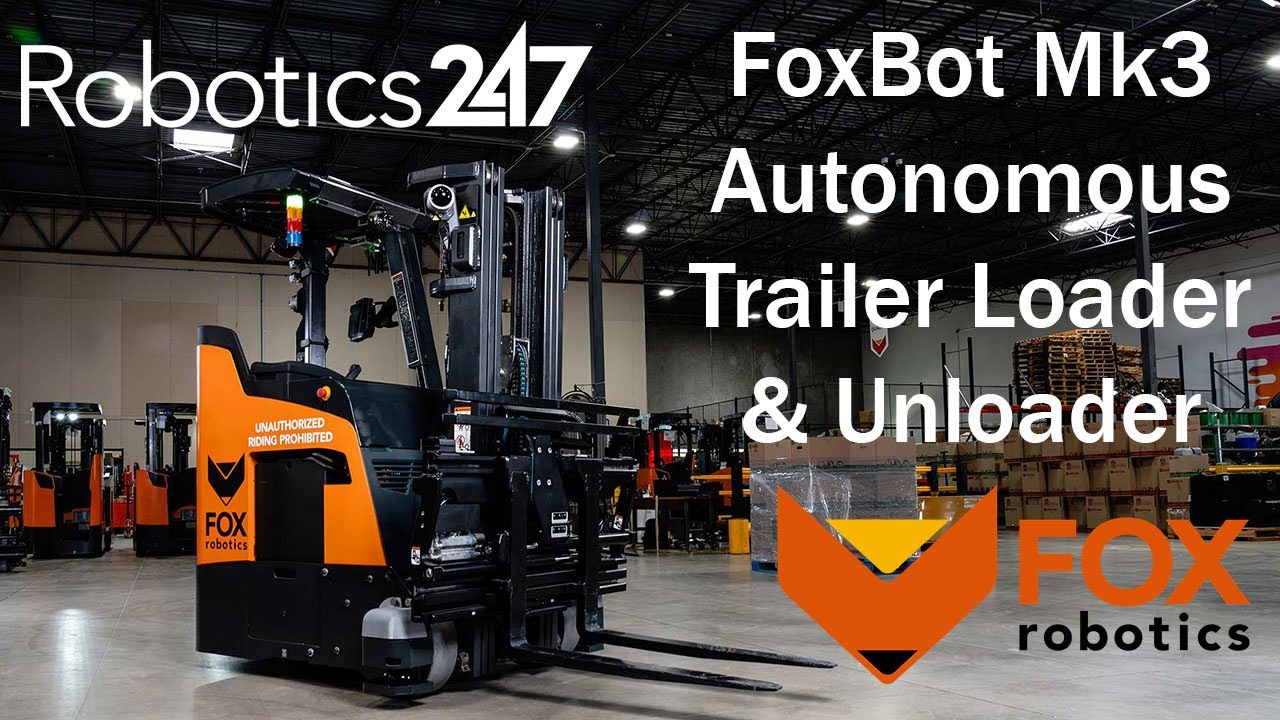
Autonomous trailer unloading represents one of the most challenging frontiers in warehouse automation. Unlike fixed conveyor systems or goods-to-person robots that operate in structured, controlled environments, trailer unloading requires a mobile robot to navigate a semi-structured, variable space — the interior of a freight trailer — while accurately identifying and retrieving pallets of varying condition and placement. Fox Robotics, based in Austin, Texas, was the first company to bring a commercially viable solution to market with its FoxBot Autonomous Trailer Loader/Unloader (ATL).
The FoxBot platform does not replace the forklift itself; instead, it augments a standard lift truck with a sensor suite and proprietary software stack that enables fully autonomous operation. This approach lowers the barrier to deployment by leveraging familiar, proven hardware and allows facilities to integrate the system without rebuilding their dock infrastructure. The technology draws on advances in robotics, machine learning, and motion planning to deliver reliable, repeatable performance in a real-world logistics environment.
Since its initial launch, the FoxBot has been adopted by major logistics operators including Walmart — which signed a multi-year partnership to deploy 19 units across its distribution network — and DHL Supply Chain, where FoxBot handles 90% of inbound freight at a dedicated distribution center. Cumulatively, the platform has surpassed 2.5 million pallet pulls in commercial operation, validating its readiness for enterprise-scale deployment.
How It Works
Core Principles
The FoxBot operates on the principle of autonomous mobile manipulation: it must navigate to a target location, perceive the environment in real time, plan a precise approach, execute a physical interaction (pallet pickup), and then transport the load safely to a designated drop zone — all without human input during the cycle. The system continuously maps its surroundings and updates its path planning to account for the dynamic conditions inside a trailer.
Key Features & Capabilities
Industry-First Autonomous Trailer Unloading Fox Robotics claims the distinction of being the first company to offer a commercially deployed automated forklift capable of unloading pallets from enclosed trailers to receiving docks. This is technically significant because the interior of a trailer presents a constrained, GPS-denied, and variably lit environment that demands robust onboard perception rather than reliance on fixed infrastructure.
Standard Lift Truck Platform Rather than designing a purpose-built robot from scratch, Fox adds sensors and software to a standard lift truck. This design philosophy reduces procurement complexity, simplifies maintenance (technicians familiar with standard forklifts can service the chassis), and lowers the total cost of deployment compared to fully custom robotic platforms.
High Throughput with Minimal Operator Oversight The FoxBot delivers over 25 pallets per hour and requires only a few minutes of operator attention per trailer — primarily for initiating the run and confirming completion. This allows a single trained operator to supervise multiple FoxBot units simultaneously, effectively multiplying the output of one worker across an entire inbound dock operation.
Proven Scalability With over 2.5 million pallet pulls logged across real customer deployments, and a product line that has evolved to the FoxBot Mk3 generation, the platform has demonstrated its ability to scale from pilot programs to full distribution center operations. Partnerships with Walmart and DHL represent some of the most demanding inbound logistics environments in the world.
Advantages & Benefits
Labor Reduction and Workforce Multiplication The most immediate benefit is the reduction in direct labor required for trailer unloading — one of the most physically demanding and injury-prone tasks in a warehouse. By enabling one operator to oversee multiple autonomous units, Fox's model transforms the role from manual driver to fleet supervisor, supporting higher-paying, less physically taxing positions.
Operational Continuity Unlike human operators, the FoxBot can run extended shifts without fatigue-related performance degradation. This is particularly valuable for distribution centers operating 24/7 or facing peak volume periods where labor availability is constrained.
Rapid and Demonstrable ROI Fox Robotics explicitly positions the FoxBot as a system that can "quickly pay for itself." In the DHL deployment, where FoxBot handles 90% of inbound freight, the labor cost savings and throughput gains are substantial enough to justify the investment within a competitive payback window. The Walmart partnership — covering 19 units across a high-tech distribution network — further reflects confidence in the financial case.
Reduced Workplace Injuries and Claims Forklift-related incidents are among the most common causes of serious warehouse injuries. Automating trailer unloading removes workers from one of the highest-risk operational contexts, with downstream benefits including lower workers' compensation costs and reduced liability exposure.
Implementation Considerations
The FoxBot performs best in environments where pallets are consistently and properly wrapped, floor surfaces are clean and well-maintained, and trailers are loaded in a relatively uniform manner. Real-world logistics environments — particularly those handling freight from multiple carriers — often present messier conditions: damaged pallets, irregular wrapping, and non-standard loading patterns. Users and observers have noted that demo footage tends to show near-ideal conditions, and performance in more chaotic inbound scenarios (e.g., double-stacked, tightly packed trailers) may require further evaluation.
Startup and calibration procedures require operator training, and early users have reported a learning curve in getting the system operational for the first run. Integration with existing dock management systems, WMS platforms, and physical infrastructure (dock levelers, trailer restraints) should be scoped carefully during the deployment planning phase. As with any autonomous mobile platform, ongoing software updates and hardware maintenance are part of the total cost of ownership.
Use Cases & Applications
Ideal For
The FoxBot is best suited for high-volume distribution centers with consistent inbound pallet flows, where trailer unloading represents a significant and recurring labor cost. Facilities that operate multiple shifts, struggle with driver recruitment, or have experienced high rates of dock-related injuries are particularly strong candidates.
Performance Metrics
- Throughput: Over 25 pallets per hour per unit
- Full trailer unload time: Under 50 minutes
- Operator attention required: A few minutes per trailer
- Cumulative pallet pulls (as of ~2024): 2.5 million+
- DHL deployment coverage: 90% of inbound freight handled autonomously
Future Trends
Fox Robotics has continued to iterate on the FoxBot platform, releasing the Mk3 generation with expanded capabilities. The broader trend in autonomous inbound logistics points toward systems that can handle increasingly variable load conditions — irregular pallet wrapping, mixed-height loads, and non-standard trailer configurations — as machine learning models are trained on larger real-world datasets. The Walmart and DHL partnerships suggest that enterprise logistics operators are moving from pilot programs to committed multi-year deployments, signaling growing confidence in the technology's maturity.
Conclusion
The Fox Robotics FoxBot represents a mature, commercially validated solution to one of warehouse automation's most persistent challenges: getting pallets out of trailers quickly, safely, and without depending on a scarce pool of forklift operators. Its approach — augmenting standard equipment rather than replacing it — lowers deployment friction and makes it accessible to a wide range of distribution environments. For operations with high inbound trailer volume, consistent pallet configurations, and a strategic interest in reducing labor dependency, the FoxBot is a compelling and proven option. Facilities considering deployment should conduct a thorough site assessment to ensure floor and pallet conditions align with the system's operational requirements.
Related Knowledge
Robotic Case Picking
Advanced robotic case picking systems that combine industrial robotics with intelligent vision systems to automate the handling of full cases and cartons, delivering exceptional speed, precision, and reliability in high-volume distribution operations.
Robotic Piece Picking
Advanced robotic systems that use AI and computer vision to automatically select and pick individual items from diverse inventory, revolutionizing warehouse fulfillment operations with human-like dexterity and intelligence.
Voice Picking Systems
Voice picking systems revolutionize warehouse operations by enabling hands-free, eyes-free order fulfillment through speech recognition technology. Workers receive spoken instructions through wireless headsets and confirm actions verbally, dramatically improving productivity, accuracy, and safety while reducing training time.
Vendor
OthersRelated Technologies
FoxBot Mk3: Third-Generation Autonomous Trailer Loader/Unloader
Fox Robotics
Mini FlyPick Robot: Compact High-Speed Sorting AMR
Others

Split Tray (Bomb Bay) Sorter Compilation: Versatile High-Speed Sortation
Others