MiR MC600 Mobile Cobot: Advanced Collaboration in Motion for Intralogistics and Production Workflows
Quick Facts
Technology Performance Metrics
⭐Key Features
Detailed Information
Product Overview
Mobile Industrial Robots (MiR) published the MC600 Workflow Solutions video on November 21, 2024 — a product capability showcase demonstrating how the Mobile Cobot 600 (MC600) transforms intralogistics and production workflows across multiple industries. The video presents the MC600 handling diverse tasks including material handling, machine tending, and quality inspection, operating up to 20 hours daily with minimal supervision in human-shared environments.
The MC600 is a mobile cobot platform that combines two complementary products from Teradyne's automation portfolio: the MiR600 autonomous mobile robot (AMR) base, which provides the navigation, safety, and transport capability, and a Universal Robots collaborative arm mounted as a top module, which provides the manipulation, interaction, and inspection capability. Together, these form a single integrated platform capable of performing tasks that neither component could accomplish alone — transporting materials autonomously through a facility while also physically interacting with machines, workstations, and products at each destination.
This combination addresses a fundamental gap in manufacturing and logistics automation: the need to automate not just the movement of materials between locations, but also the manipulation tasks that occur at each location. Conventional AMRs deliver materials to a point and stop; the MC600 can deliver and then perform work at the destination — tending a machine, picking from or placing into a fixture, or conducting a visual quality inspection — before autonomously navigating to the next task.
MiR is headquartered in Odense, Denmark, and is a subsidiary of Teradyne, Inc. Universal Robots, also headquartered in Odense and also a Teradyne subsidiary, manufactures the collaborative robot arms that form the manipulation layer of the MC600. The shared Teradyne ownership of both companies enables tight hardware and software integration between the MiR mobility platform and the UR arm — a structural advantage over third-party mobile cobot configurations that require custom integration between independently developed platforms.
System Integrator Note
System Integrator: N/A — Product Showcase Video
This video is a product-level capability demonstration rather than a named customer case study. MiR distributes the MC600 and its broader AMR product line through an authorized global network of system integrators, distributors, and certified solution partners. In actual customer deployments, MiR-certified integration partners handle site assessment, layout planning, top module selection and configuration, mission programming, fleet management setup, and commissioning. For deployments where the system integrator is identified, this information is documented in MiR's individual customer case study videos — several of which are available in the MiR YouTube channel library, including case studies for Megatech Industries, Kashiyama, Vestfrost Solutions, Kinrise, and E. Gulbja Laboratory.
Industry Context: The Mobile Cobot Opportunity
The emergence of mobile cobots as a distinct automation category reflects the convergence of two previously separate technology lineages: autonomous mobile robots (AMRs), which solve the problem of autonomous navigation and internal transport, and collaborative robots (cobots), which solve the problem of safe, flexible manipulation in human-shared environments. Each category, taken alone, addresses a partial automation problem. AMRs automate transport but cannot interact with the environment at the destination. Cobots automate manipulation at a fixed location but cannot move between locations autonomously. The mobile cobot category combines both capabilities in a single platform, enabling a new class of automation use cases that neither technology could address independently.
For manufacturing and intralogistics environments, this convergence is particularly significant because many of the highest-value automation opportunities involve both transport and manipulation in sequence: moving a component from a storage location to a machine, loading the machine, waiting for the operation to complete, unloading the finished part, and transporting it to the next station. This end-to-end workflow requires both mobility and manipulation — and historically required either a human worker or a combination of fixed conveyor infrastructure and fixed robot arms, each of which carries significant inflexibility and cost.
The MC600 is MiR's response to this opportunity, positioned as a platform capable of handling the full transport-plus-manipulation workflow in a single, flexible, reprogrammable unit that can operate safely alongside human workers without dedicated safety barriers.
Technical Solution
MiR600 Autonomous Mobile Platform
The MC600 is built on the MiR600 AMR base, which provides a payload capacity of 600 kg and MiR's full suite of autonomous navigation and safety technology. The MiR600 uses a combination of laser scanners and 3D cameras to map its environment, detect obstacles, and navigate autonomously through dynamic facilities without fixed infrastructure such as magnetic tape or QR codes. The safety system is certified to relevant industrial safety standards, enabling operation in human-shared environments without physical barriers.
The MiR600 base handles all navigation, obstacle avoidance, fleet coordination, and charging autonomously — including automatic docking to charging stations to maintain battery levels across long operating shifts. The platform's fleet management software enables multiple MC600 units to operate in coordination, with centralized mission assignment, traffic management, and monitoring.
Universal Robots Collaborative Arm Integration
The collaborative robot arm mounted on the MC600 top plate is sourced from Universal Robots, MiR's fellow Teradyne subsidiary. UR's cobot arms are designed for inherently safe operation alongside humans — with force and torque sensing that enables the arm to detect contact and stop safely, eliminating the need for the fixed safety barriers and exclusion zones required by traditional industrial robot arms.
The UR arm's programming interface (Polyscope) enables rapid task programming and reconfiguration — a critical capability for a mobile platform that may be reassigned to different tasks or workstations as production demands change. The combination of MiR's mission-based navigation programming and UR's task-based arm programming creates a unified workflow in which the robot navigates to a location, executes a manipulation task, and then navigates to the next location — all within a single integrated mission sequence.
Multi-Task Capability
The MC600 video showcases three primary task categories that the platform can perform across industries:
Material Handling and Internal Transport — The most direct extension of the MiR600's core AMR capability, augmented by the cobot arm's ability to pick, place, and handle items at the transport destination rather than simply delivering a cart or shelf.
Machine Tending — The MC600 navigates to a production machine, uses the cobot arm to load raw material or a workpiece into the machine, waits for the operation to complete, and then unloads the finished part — automating a repetitive, physically demanding task that typically occupies a human operator full-time at each machine.
Quality Inspection — The MC600 uses the cobot arm (typically equipped with a camera or sensor payload) to perform visual or dimensional inspection of parts or products, either at a dedicated inspection station or inline at the production or packaging point.
Operating Hours and Supervision
The MC600 is designed to operate up to 20 hours daily with minimal supervision. This operating profile is enabled by the combination of autonomous navigation (which eliminates the need for an operator to direct the robot's movement), automatic charging (which maintains battery levels without human intervention), and the collaborative safety design (which allows the robot to operate in occupied areas without requiring a dedicated safety monitor). The 20-hour figure represents a significant utilization advantage over human-staffed operations limited to standard shift patterns.
Key Performance Claims
Daily Operating Hours: Up to 20 hours per day with minimal supervision — enabling multi-shift equivalent utilization from a single robot platform without the shift scheduling, fatigue management, or overtime costs associated with human labor.
Collaborative Safety: Operation alongside human workers in shared environments without fixed safety barriers — enabled by MiR's safety-certified navigation and Universal Robots' inherently safe cobot arm design.
Multi-Task Flexibility: A single platform capable of material handling, machine tending, and quality inspection — reducing the number of dedicated automation systems required to cover a given set of workflow tasks.
Dynamic Adaptability: Effortless adaptation to changing environments and production demands — enabled by the platform's autonomous navigation (which does not require fixed infrastructure) and flexible mission and task programming (which enables rapid reconfiguration for new workflows).
Competitive Positioning
The MC600 occupies a distinctive position in the mobile automation market by combining MiR's leadership in the AMR segment with Universal Robots' leadership in the collaborative robot arm segment — both within the same Teradyne corporate family. This structural integration provides a level of hardware and software cohesion that is difficult for competitors to replicate through third-party partnerships between independently developed platforms.
Against pure AMR platforms, the MC600 extends automation scope from transport-only to transport-plus-manipulation, enabling the platform to address machine tending and inspection use cases that AMRs alone cannot handle. Against fixed cobot installations, the MC600's mobility eliminates the single-workstation limitation, enabling one robot to serve multiple machines or workstations in sequence. Against traditional industrial robots, the collaborative design enables operation in human-shared environments without barriers — a critical advantage in facilities where human workers and automated systems must coexist in the same space.
Company Context: Mobile Industrial Robots (MiR)
Mobile Industrial Robots (MiR) is headquartered in Odense, Denmark, and was acquired by Teradyne, Inc. in 2018. MiR develops and manufactures a range of autonomous mobile robots spanning payload capacities from 100 kg (MiR100) to 1,350 kg (MiR1350), along with specialized platforms including the MiR1200 Pallet Jack. The MC600 mobile cobot platform extends MiR's product line into the manipulation domain by integrating Universal Robots' collaborative arms — also a Teradyne company since 2015 — onto MiR's AMR bases.
MiR distributes its products through a global network of authorized system integrators and distributors, with documented customer deployments across manufacturing, pharmaceuticals, food and beverage, electronics, and logistics sectors. The YouTube channel library includes case studies from Megatech Industries, Kashiyama, Vestfrost Solutions, Kinrise, E. Gulbja Laboratory, and others, providing a reference base of real-world deployment outcomes across diverse industries and geographies.
More information is available at mir-robots.com.
Note on Data Availability
The performance metrics cited in this document (20 hours daily operation, minimal supervision) are drawn directly from the MiR video description published on November 21, 2024. As a product showcase video rather than a named customer case study, no client-specific operational data, ROI figures, or deployment-specific metrics are disclosed. Named customer deployments with quantitative performance data are documented in separate case study videos in the MiR YouTube channel library. The system integrator field is not applicable to this video; for named customer deployments, system integrator information is documented in the relevant case study records.
Related Projects
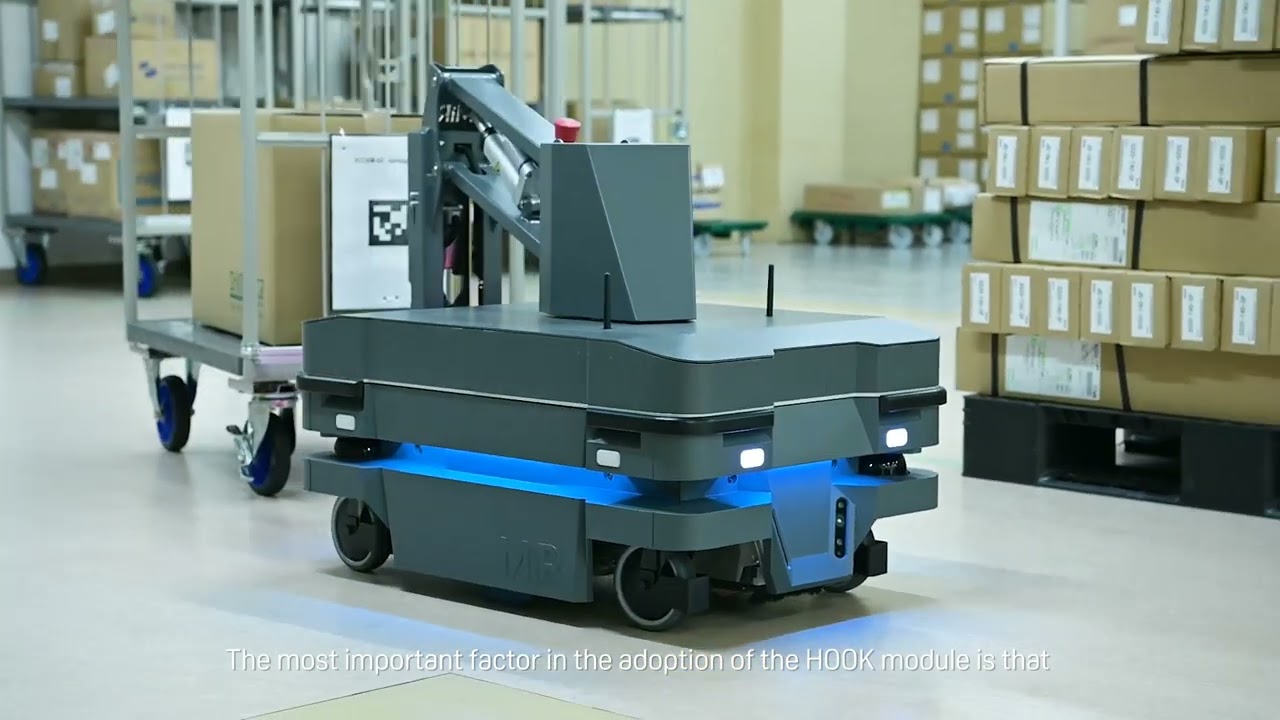
Shigemasa Co., Ltd. Deploys MiR250 Hook AMR to Automate Cart Transport After Warehouse Expansion
Shigemasa Co., Ltd., a machinery parts and tools supplier based in Fukuyama-shi, Hiroshima, Japan, deployed a MiR250 Hook autonomous mobile robot to automate cart towing operations after a warehouse expansion significantly increased internal transport distances. The MiR250 Hook — an AMR with a patented towing hook top module — autonomously collects carts from designated yard locations and delivers them to shipping bases in response to instructions from the company's inventory management system. Key selection criteria included no infrastructure change requirements, multi-device remote operation capability, a simple one-click user interface, and pre-installation verification at the DAIKI ROBOTICS Robotics Lab in Osaka. The deployment freed human workers from repetitive transport tasks to focus on work that only humans can do, and was selected over AGV and competing AMR solutions that required magnetic tape, layout changes, or manual loading and unloading.
Megatech Industries Deploys 4 MiR250 AMRs to Automate Internal Logistics in Automotive Plastics Manufacturing
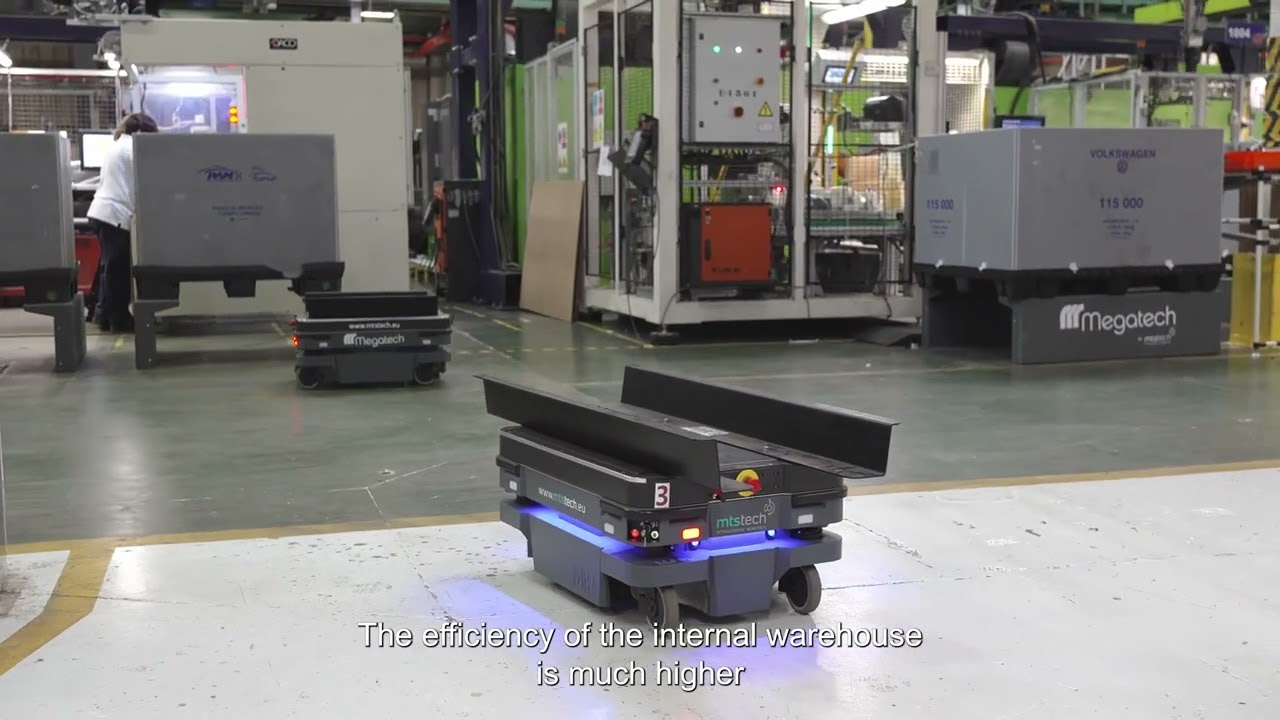
Megatech Industries, a manufacturer of plastic parts for the automotive sector, deployed four MiR250 autonomous mobile robots at its plant in Amurrio, Basque Country, Spain. The robots automate the removal of finished containers from production lines, transport them to the warehouse, and return empty containers to continue production — replacing forklift-based logistics. The deployment delivered a significant reduction in forklift incidents, elimination of production bottlenecks, improved ergonomics for operators, and an estimated annual return on investment of approximately €100,000. MiR fleet control was integrated into Megatech's own software via MiR's official distributor MTS Tech, giving the team real-time visibility and control over all robot missions. Following the success at Amurrio, Megatech is evaluating expansion to its facilities in Ourense, Spain, and the Czech Republic.
Dongfeng Motor R&D Center Smart Logistics Warehouse
A compact 470㎡ intelligent warehouse with 15-level high-density storage supporting 10,000+ SKUs for automotive R&D supply chain optimization.